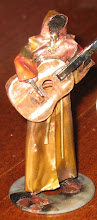
i happened into the "p" section of
websters new world dictionary
and while i can't remember
what it was i was looking for
i came across the word
psalm
i knew that the word derived from the ancient greek term
psalterion
which refers to stringed instruments
such as the lyre the kithera the zither
the "lute" (from the KJ trans.)
and finally the psaltery
with which we see King David
often portrayed
the definition struck a chord as it were
for it gives the ancient spellings and pronunciations
such a saumes - psalme - psallein
but then then are you ready
the greek indication is
psalmos -- a twanging with the fingers
this further substantiates a notion i have been
proposing in church circles
the psalms are best accompanied by stringed instruments
and the word twang seems to pre-date
country and western usage
an onomatopoeic word
it sounds like what it does
more twang in church
that's what i say
yeah
Sunday, April 29, 2007

Saturday, April 28, 2007
the fight...a digression
ever since reading paul bermans' book
"terror and liberalism"
i have been using the thesis of that book
as the "frame" by which i somehow picture
the mess we are in in my mind
perhaps this is the best anyone can do
any one book or policy commentator
is not sufficient to grasp the complexity
of a situation such as we find ourselves
as a nation...insofar as you or i acknowledge our
status within this nation
and i will admit to some reservation on that account
however that book did help me to see
the cultural development into which
osama bin laden immersed himself
the critique of the modern west
of "liberalism" by one sayyid qutb
in his "in the shadow of the koran"
is the literary and philosophical context
or at least one of the leading ones
which has fomented modern islamic extremism
it is the conclusion of qutb
that the west
in allowing for "atheism" to influence
the culture...his view of the philosophies of
existentialism (the french variety) rationalism
mathematical rationalism scientism
all leading somehow to the materialistic world we know
and threatening somehow to "corrupt"
the world of islam
requires a radical reaction on the part of islam
a rejection of the culture of the west
the culture which bush refers to as
"our freedom" may include that notion of religious
freedom which marks the openness of our society
i don't know
i can only conjecture
that bush has a less than adequate understanding of the
intricacies and i would go so far as to say
the intrinsic nobility of islamic culture
perhaps we have all fallen short on that point
do we really regard our culture as superior to theirs?
simply because we can buy anything
we can say anything
we can act any way we want
as long as we don't hurt anyone
it is interesting then to note
that benedict the 16th
makes a similar observation
when making a very subtle critique of his own
in the speech he gave at regensburg
last fall and has restated in other ways since
while obviously and earnestly stating to the islamic world
that our "faiths" need to be reasonable
he was also making a summarization of the rise of
atheisitc world views in the west
views which have for all practical purposes
rejected the christian world view
and in its place installed a very rough version
of the humanistic postivistic ideal
of self-management
with the human at the center of everything
ironically it is a philosophy which states
"man is reasonable and with his reason he can create and manage
a reasonable world for himself"
one has to wonder about the success of that vision
but we cannot doubt its power
it is rather strange for me to come to the awareness that qutb
and the holy father are basically thinking along the
same lines
although the sense in catholic circles is more
that the world of secularism
is but a rebellious adolescent child of christianity
when she grows up a bit she'll see her folly
but i am skeptical
i do understand that it could be an insult
to a culture to have the commercialized images
to which we ourselves have become so inured
come crashing into view
with no sense of prudence or sensitivity
there seems to me in islam
even while i am aware of some outrageouos opulence
a practiced sort of simplicity
a willingness to live with very little
and i sense that that is the case for most of the billion
muslims in the world
and i don't know that that means that they suffer
although i am sure some do
i only contrast that with the deadened overfed
confused doped up sensibility of america
wherein so many of us are oblivious
even to ourselves and what we have become
bin laden
and his crew see us as hopelessly corrupt
and thereby dangerous to his beloved islamic
vision of the world
benedict also addresses the
blindness and the closemindedness of the west
and holds out the hand of
reasonable discussion
is it possible?
paul bermans' book
while not citing the holy father
at least seems to agree on the source and link of
liberalism in the west and the
reaction from the ranks of extremist islam
something to think about on a slow day
i wonder what a man my age in baghdad
who could easily be my friend
is thinking today
thinkin
"terror and liberalism"
i have been using the thesis of that book
as the "frame" by which i somehow picture
the mess we are in in my mind
perhaps this is the best anyone can do
any one book or policy commentator
is not sufficient to grasp the complexity
of a situation such as we find ourselves
as a nation...insofar as you or i acknowledge our
status within this nation
and i will admit to some reservation on that account
however that book did help me to see
the cultural development into which
osama bin laden immersed himself
the critique of the modern west
of "liberalism" by one sayyid qutb
in his "in the shadow of the koran"
is the literary and philosophical context
or at least one of the leading ones
which has fomented modern islamic extremism
it is the conclusion of qutb
that the west
in allowing for "atheism" to influence
the culture...his view of the philosophies of
existentialism (the french variety) rationalism
mathematical rationalism scientism
all leading somehow to the materialistic world we know
and threatening somehow to "corrupt"
the world of islam
requires a radical reaction on the part of islam
a rejection of the culture of the west
the culture which bush refers to as
"our freedom" may include that notion of religious
freedom which marks the openness of our society
i don't know
i can only conjecture
that bush has a less than adequate understanding of the
intricacies and i would go so far as to say
the intrinsic nobility of islamic culture
perhaps we have all fallen short on that point
do we really regard our culture as superior to theirs?
simply because we can buy anything
we can say anything
we can act any way we want
as long as we don't hurt anyone
it is interesting then to note
that benedict the 16th
makes a similar observation
when making a very subtle critique of his own
in the speech he gave at regensburg
last fall and has restated in other ways since
while obviously and earnestly stating to the islamic world
that our "faiths" need to be reasonable
he was also making a summarization of the rise of
atheisitc world views in the west
views which have for all practical purposes
rejected the christian world view
and in its place installed a very rough version
of the humanistic postivistic ideal
of self-management
with the human at the center of everything
ironically it is a philosophy which states
"man is reasonable and with his reason he can create and manage
a reasonable world for himself"
one has to wonder about the success of that vision
but we cannot doubt its power
it is rather strange for me to come to the awareness that qutb
and the holy father are basically thinking along the
same lines
although the sense in catholic circles is more
that the world of secularism
is but a rebellious adolescent child of christianity
when she grows up a bit she'll see her folly
but i am skeptical
i do understand that it could be an insult
to a culture to have the commercialized images
to which we ourselves have become so inured
come crashing into view
with no sense of prudence or sensitivity
there seems to me in islam
even while i am aware of some outrageouos opulence
a practiced sort of simplicity
a willingness to live with very little
and i sense that that is the case for most of the billion
muslims in the world
and i don't know that that means that they suffer
although i am sure some do
i only contrast that with the deadened overfed
confused doped up sensibility of america
wherein so many of us are oblivious
even to ourselves and what we have become
bin laden
and his crew see us as hopelessly corrupt
and thereby dangerous to his beloved islamic
vision of the world
benedict also addresses the
blindness and the closemindedness of the west
and holds out the hand of
reasonable discussion
is it possible?
paul bermans' book
while not citing the holy father
at least seems to agree on the source and link of
liberalism in the west and the
reaction from the ranks of extremist islam
something to think about on a slow day
i wonder what a man my age in baghdad
who could easily be my friend
is thinking today
thinkin
Friday, April 27, 2007
kant and thomas aquinas
it occured to me today that the 19th century search for a bridge
between the seeming metaphysical dead end of kant
and the vastly openended positive explanation of thomas aquinas
is linked to the idea which both philosophers arrived at
thomas was rather insistent concerning the idea that
"we can only speak of god in terms of what he is not"
and i think guys like joseph marechal and later otto muck
saw kant's upending of st anselm's proof as similar to thomas's
doubts abot that proof
although thomas never explicitly defies the idea of anselm
he does not develop this notion that
"god is that of which nothing greater can be thought"
kant makes a purely rational and i would say
nearly inarguable conclusion ---
"man cannot see god...ergo...man can have no idea
as to what god is....ergo...there is really no way to think about
or discuss for that matter what we mean when we use the word
'Gott' " as emmanuel would have said
it's the stuff of prayer and faith
and not to be a confusing element
in the proceedings of serious philosophy
hobbes is perhaps credited
with a more concise dismissal
of theological considerations in philosophy
but kant followed suit
therefor it is not so much that kant
set up an impermeable road block
for metaphysics
it is simply that he claims
that there is no way to talk of god
on reasonable terms
if in fact we have no concept of god
(other than those anthropomorphic references in scripture)
the "faith" response in the world of protestant intellectualism
was to proclaim open season on the bible
and submit this book to all kinds of rational scrutiny
because in fact we can speak of a text
we can be rational and reasonable about
the meanings of stories and
the excercise of ever more accurate translation
the "historical-critical" method
the linguistic analytic techniques
the application of social theory
even the process of "mytho-analysis"
and dream theory have weighed in on the
modern discussion of scripture
the book has been all but divorced
from philosphical dialogue in the past
250 yrs
it seems to me however that the jesuits (primarily)
who saw a necessary position in kant
whether it was comfortable or not
sought to bring him into line with thomas
on this very principle
wherein they in effect agree
thomas however maintained that
in the understanding of anything
including god
our natural cognitive propensity for analogy
is useful
in fact that is the fundamental "tool"
of cognition
we only know because we know something else
we can speak of perfection as we know it
and experience it
and we can lean on the "transcendental virtues"
such as truth and goodness and beauty
as a way of articulating those thoughts which
come about quite naturally
finally it is the view of thomas
that what we know as "mind"
is the human attribute which most likens us
to god
and therefore that natural inclination of the mind
to "know" has its natural completion in
something much beyond our human comprehension
thomas would say as well
that unless motivated by the awareness of ignorance
there would be no incentive to "know"
he would also digress to a mystical language
when saying
"the heart yearns to know love"
and that is a far more powerful desire
than simply knowing about the world and all that is in it
suffice
between the seeming metaphysical dead end of kant
and the vastly openended positive explanation of thomas aquinas
is linked to the idea which both philosophers arrived at
thomas was rather insistent concerning the idea that
"we can only speak of god in terms of what he is not"
and i think guys like joseph marechal and later otto muck
saw kant's upending of st anselm's proof as similar to thomas's
doubts abot that proof
although thomas never explicitly defies the idea of anselm
he does not develop this notion that
"god is that of which nothing greater can be thought"
kant makes a purely rational and i would say
nearly inarguable conclusion ---
"man cannot see god...ergo...man can have no idea
as to what god is....ergo...there is really no way to think about
or discuss for that matter what we mean when we use the word
'Gott' " as emmanuel would have said
it's the stuff of prayer and faith
and not to be a confusing element
in the proceedings of serious philosophy
hobbes is perhaps credited
with a more concise dismissal
of theological considerations in philosophy
but kant followed suit
therefor it is not so much that kant
set up an impermeable road block
for metaphysics
it is simply that he claims
that there is no way to talk of god
on reasonable terms
if in fact we have no concept of god
(other than those anthropomorphic references in scripture)
the "faith" response in the world of protestant intellectualism
was to proclaim open season on the bible
and submit this book to all kinds of rational scrutiny
because in fact we can speak of a text
we can be rational and reasonable about
the meanings of stories and
the excercise of ever more accurate translation
the "historical-critical" method
the linguistic analytic techniques
the application of social theory
even the process of "mytho-analysis"
and dream theory have weighed in on the
modern discussion of scripture
the book has been all but divorced
from philosphical dialogue in the past
250 yrs
it seems to me however that the jesuits (primarily)
who saw a necessary position in kant
whether it was comfortable or not
sought to bring him into line with thomas
on this very principle
wherein they in effect agree
thomas however maintained that
in the understanding of anything
including god
our natural cognitive propensity for analogy
is useful
in fact that is the fundamental "tool"
of cognition
we only know because we know something else
we can speak of perfection as we know it
and experience it
and we can lean on the "transcendental virtues"
such as truth and goodness and beauty
as a way of articulating those thoughts which
come about quite naturally
finally it is the view of thomas
that what we know as "mind"
is the human attribute which most likens us
to god
and therefore that natural inclination of the mind
to "know" has its natural completion in
something much beyond our human comprehension
thomas would say as well
that unless motivated by the awareness of ignorance
there would be no incentive to "know"
he would also digress to a mystical language
when saying
"the heart yearns to know love"
and that is a far more powerful desire
than simply knowing about the world and all that is in it
suffice
Tuesday, April 24, 2007
chewing existential cud
rumination
april 22 was earth day
and that is good
but too much ignorance
whips about in the wind
like discarded plastic bags
it was also the birthday of
the woman i loved more than anyone
for all too short of a time
years ago
but the pain of loss still
like a pin to the heart
hurts my mind
it was also the occasion
of a brilliant musical performance
in a little chapel in SE arizona
tim wiedenkeller
and his amazing banjo
i am presently immersed in a philosophical dilemma
concerning the observation by emmanuel kant
which more or less destroyed the
practice of theoretical theology
in protestant circles
and gave rise to the scientific rational
dissection of scripture
his position was that because it is impossible
for man to have any sort of actual visible
or imagined concept of "the absolute" or
god
that therefore it is also impossible
then to have any discussion concerning
what man is incapable of conceiving
he is basically taking on the "proof"
of st anselm which states
god is " that which no greater can be conceived"
anselm held that even though we cannot see god
the fact that we have in our minds the notion of god
is sufficient to suggest to the mind that god therefore exists
karl rahner then utilizes the thomistic idea of
the epistemological problem for cognition
in his work SPIRIT IN THE WORLD
in an effort to address the negation of kant
and make the ideas and the proofs according
to thomas aquinas more accessible
to modern philosophical discourse
i am not sure if he succeeded just yet
i'll have to finish the book by rahner
i think whether or not rahner properly mitigates the difficulty
presented by classical rationalism and empiricism
not to mention the renewed platonic dualism of descartes
it is important to come to some sort of agreement as to
what we are doing when we philosophize
the objective is wisdom
enough said
sayeth
anon
april 22 was earth day
and that is good
but too much ignorance
whips about in the wind
like discarded plastic bags
it was also the birthday of
the woman i loved more than anyone
for all too short of a time
years ago
but the pain of loss still
like a pin to the heart
hurts my mind
it was also the occasion
of a brilliant musical performance
in a little chapel in SE arizona
tim wiedenkeller
and his amazing banjo
i am presently immersed in a philosophical dilemma
concerning the observation by emmanuel kant
which more or less destroyed the
practice of theoretical theology
in protestant circles
and gave rise to the scientific rational
dissection of scripture
his position was that because it is impossible
for man to have any sort of actual visible
or imagined concept of "the absolute" or
god
that therefore it is also impossible
then to have any discussion concerning
what man is incapable of conceiving
he is basically taking on the "proof"
of st anselm which states
god is " that which no greater can be conceived"
anselm held that even though we cannot see god
the fact that we have in our minds the notion of god
is sufficient to suggest to the mind that god therefore exists
karl rahner then utilizes the thomistic idea of
the epistemological problem for cognition
in his work SPIRIT IN THE WORLD
in an effort to address the negation of kant
and make the ideas and the proofs according
to thomas aquinas more accessible
to modern philosophical discourse
i am not sure if he succeeded just yet
i'll have to finish the book by rahner
i think whether or not rahner properly mitigates the difficulty
presented by classical rationalism and empiricism
not to mention the renewed platonic dualism of descartes
it is important to come to some sort of agreement as to
what we are doing when we philosophize
the objective is wisdom
enough said
sayeth
anon
Sunday, April 22, 2007
the miracle of water
i read a book yesterday
the author is a japanese buddhist
scientist
who experimented with
the moment of crystalization of water
and the effect of various stimuli
such as musical sound vibrations
on the forming crystals
he developed a technique of photography
which captures the formed crystal
it is his thesis that water
being the basis of life
registers not only sound
but actually picks up vibrations in the air
of "mindset" and even the written word
negativity seems to disrupt the formation
of crytals
positivity like the word love lends
itself to the formation of more perfect
hexegonal shapes
i will return to this theme
with the name of the author
and more detail about his experiment
and photographs
anon
the author is a japanese buddhist
scientist
who experimented with
the moment of crystalization of water
and the effect of various stimuli
such as musical sound vibrations
on the forming crystals
he developed a technique of photography
which captures the formed crystal
it is his thesis that water
being the basis of life
registers not only sound
but actually picks up vibrations in the air
of "mindset" and even the written word
negativity seems to disrupt the formation
of crytals
positivity like the word love lends
itself to the formation of more perfect
hexegonal shapes
i will return to this theme
with the name of the author
and more detail about his experiment
and photographs
anon
Saturday, April 21, 2007
as a beginning
perhaps a poem
a making
something echoing forth
from the regions of disturbed insight
the harsh necessity of knowing
we all know the world for what it is
no need to disregard those words
but we do ignore the truth
and in its place
place our perceptions and imaginings
skimpy reflections of a shattered mirror
reality is too much
unless taken with doses of prayer
or sitting silent for long moments
or even with the glass of amber liquid
on ice
but even then we admit deeply to ourselves
if not to anyone else
it is too much
i have only wished to sing
and though my voice cracks
and the loose gravel in my throat rattles the tune
i will not reserve my heart
you may not like the song
but don't ignore the singer
for god's sake
perhaps a poem
a making
something echoing forth
from the regions of disturbed insight
the harsh necessity of knowing
we all know the world for what it is
no need to disregard those words
but we do ignore the truth
and in its place
place our perceptions and imaginings
skimpy reflections of a shattered mirror
reality is too much
unless taken with doses of prayer
or sitting silent for long moments
or even with the glass of amber liquid
on ice
but even then we admit deeply to ourselves
if not to anyone else
it is too much
i have only wished to sing
and though my voice cracks
and the loose gravel in my throat rattles the tune
i will not reserve my heart
you may not like the song
but don't ignore the singer
for god's sake
Friday, April 20, 2007
Subscribe to:
Posts (Atom)