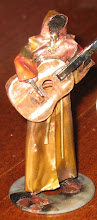
there comes a moment when the fate of the prophet john is sealed
sealed in the knowledge of blood soon to be spilling from his neck
to be a prophet means to speak the word of god
whether timely or untimely
and there is no right time to die
or
in the new kingdom
any day may be the right time
it was john's mission and his greatness
to proclaim the advent of the kingdom
the kingdom has come near to us
our challenge is to enter
at the price of our own earthly happiness
at the price of our practiced contentment
to stand against violence may be the violence we get
to be a voice for peace may bring anything but peace
let us concentrate for a moment on john's fate
he lies in prison
a powerless victim of wretched paltriness
and fully aware of the death threatening him
from herodias' hatred
must not the knowledge of his own greatness
have revolted against the apparent senselessness
of it all
surely his darkest hours came then
and with them danger of rebellion and doubt
can he who allows such things to happen to his servants
really be the messiah
perhaps all the complexities of human love are contained in this story
love that seeks to be certain in marriage
love that binds friends
love that is dedicated to the well-being of others
even the basic love as affection is on trial
surely the concept of love of god is called into question
"blessed is he who is not scandalized in me"
these words sent to john from jesus
as john paces his cell
the lord knows his herald
knows his need
the message sent by the mouth
of his uncomprehending disciples
into the darkness of the dungeon
is a divine message
john understood
ours is bloody faith
and in that blood spilled from johns death wounds
co-mingled in the blood that spilled
from jesus' side and down his face
we have a mandate for the kingdom
here on earth
our very lives are asked of us
this reflection was inspired by the reading from
morning office which comes to us from
THE LORD by romano guardini
the words in bold type
are the words of romano guardini
the original text is in italian
Friday, August 29, 2008

Wednesday, August 27, 2008
altering a poem by denise levertov
she would be the same age as my father
had she not died in 1997
she was perhaps the greatest woman poet
of her age
for purposes of my own deciding
i will take this poem
out of the 6 questions
6 answers format
and
answer each question
with the answer
poetically given
thus there will be an
immediate cohesiveness
which obviously existed
in the mind of the poet
but i will establish here
as is my wont
WHAT WERE THEY LIKE?
1) Did the people of Viet Nam
use lanterns of stone?
....Sir, their light hearts turned to stone.
It is not remembered whether in gardens
stone lanterns illumined pleasant ways.
2) Did they hold ceremonies
to reverence the opening of buds?
....Perhaps they gathered once to delight in blossom,
but after the children were killed
there were no more buds.
3) Were they inclined to quiet laughter?
....Sir, laughter is bitter to the burned mouth.
4) Did they use bone and ivory,
jade and silver, for ornament?
....A dream ago perhaps. Ornament is for joy.
All the bones were charred.
5) Had they an epic poem?
....It is not remembered. Remember,
most were peasants; their life
was in rice and bamboo.
When peaceful clouds were reflected in the paddies,
and the water buffalo stepped surely along the terraces,
maybe fathers told their sons old tales.
When bombs smashed those mirrors
there was time only to scream.
6) Did they distinguish between speech and singing?
...There is an echo yet
of their speech which was like a song.
It was reported their singing resembled
the flight of moths in moonlight.
Who can say? It is silent now.
Ms Levertov used the form
of a court briefing
or a military manual of some sort
which suggests a straightforward
businesslike approach to all matters
6 questions asked
6 questions answered
i on the other hand wish to use the call and response
approach here because i hear a conversation of some sort
so while acknowledging ms levertovs' published intent
i have merged the two parts of the poem
in order to lend the responses some immediacy
to the questions
that is all
had she not died in 1997
she was perhaps the greatest woman poet
of her age
for purposes of my own deciding
i will take this poem
out of the 6 questions
6 answers format
and
answer each question
with the answer
poetically given
thus there will be an
immediate cohesiveness
which obviously existed
in the mind of the poet
but i will establish here
as is my wont
WHAT WERE THEY LIKE?
1) Did the people of Viet Nam
use lanterns of stone?
....Sir, their light hearts turned to stone.
It is not remembered whether in gardens
stone lanterns illumined pleasant ways.
2) Did they hold ceremonies
to reverence the opening of buds?
....Perhaps they gathered once to delight in blossom,
but after the children were killed
there were no more buds.
3) Were they inclined to quiet laughter?
....Sir, laughter is bitter to the burned mouth.
4) Did they use bone and ivory,
jade and silver, for ornament?
....A dream ago perhaps. Ornament is for joy.
All the bones were charred.
5) Had they an epic poem?
....It is not remembered. Remember,
most were peasants; their life
was in rice and bamboo.
When peaceful clouds were reflected in the paddies,
and the water buffalo stepped surely along the terraces,
maybe fathers told their sons old tales.
When bombs smashed those mirrors
there was time only to scream.
6) Did they distinguish between speech and singing?
...There is an echo yet
of their speech which was like a song.
It was reported their singing resembled
the flight of moths in moonlight.
Who can say? It is silent now.
Ms Levertov used the form
of a court briefing
or a military manual of some sort
which suggests a straightforward
businesslike approach to all matters
6 questions asked
6 questions answered
i on the other hand wish to use the call and response
approach here because i hear a conversation of some sort
so while acknowledging ms levertovs' published intent
i have merged the two parts of the poem
in order to lend the responses some immediacy
to the questions
that is all
Tuesday, August 19, 2008
knowing and politics
as we grow to adulthood it seems
we get interested in how the world
around is working
what are the trends
who has the power
who decides the laws
who gets the breaks
who gets broken
what can i get away with
who takes care of the streets
whom do i serve
whether consciously or un-
some folks become die-hard apatheticos
not wanting anything to do with
the social structures of governance
most thinking and reading people however
engage in some form of discernment
and discussion as to the qualities
and merits of the people who set out
to work in the arena of civil service
and wish to partake in the procedures
which serve to create laws
the notion of politics as a means of discourse
requires that a person first of all
believe that some form of change through
the action of participation in legal deliberation
is possible
the person must also have considerable
self-confidence that he or she can work
to bring about some form of change for the
benefit of others
the american system has been worked out
in a slow continuum of history
dating as far back as the greek polis
and the philsophical contributions
of plato and aristotle the stoics and the
epicureans and later the romans
the notion of individual liberty
as a right accorded by government
is really quite recent
up until the 18th century
it was held that individual liberty
was either something one was born into
or was accorded a person based on their
level of education
while it would be difficult to prove that
before the system of voting we know of today
was in place that people did not have any effect on
the processes of their immediate social settings
it is safe to say that the institution of
voting as a means of establishing laws
and choosing leaders was pioneered
in the New World
(the Magna Carta aside)
so what do i proclaim when i assert
that i am for a particular person
and would vote for that person
to be president or governor or
city alderman or mayor or
school board director
is it ever a case that people discern
that the public good might have to
take precedence over more selfish values
for instance
i have made it clear that i vote the democratic ticket
in my mind however i know that i am an independent
and i see no contradiction here
FDR once stated that he was a member of no
political party
he said: i am a democrat
when i say
i will vote for barack obama
what am i saying as far as
what i know
i do not know the man personally
i know something of his biography
primarily through the reading of
articles and essays of political writers
and watching and reading the news
i know his political views
from watching and listening to him
speak along the campaign trail
in some regards i must admit that
my favoring this canditate (presumptive at this point
...it could change at the convention next week...
highly doubtful however)
is a position of reaction
i know only disappointment as i look
over the past 8 yrs of domestic
and foreign policy
the primary motivation for governing
at the federal level centers around a war
a world wide effort to curtail terrorism
there is nothing to indicate that the
effort in iraq has resulted in a safer world
and if anything given the inclination
to blood vengeance mixed with
religious zeal
the stakes might be quite a bit higher
than they were before 9/11
american pragmatism is no match for
the earth bound sense of destiny
articulated in islamic fundamentalist rhetoric
i do know that the experience of 9/11
is to be understood in terms of religion more
than in politics
however it seems we have assumed
the political option for resolution
which includes conducting a war
a war that will not simply end
thus i make up my mind based on what
i know and judge to be important
i know war is a bad idea
and it rarely solves anything
there may be resolution when
the fighting stops but the scars are
forever re-opening
i know that i do not approve of
the two party system of american voting
it seems on the one hand rather
efficient to divide the contest
into two sides of looking at important
social issues and problems
and it plays itself down to a sort of
highschool debate that doesn't cease
i know also that the fate of a country
is not in the hands of a leader
the most a leader can do is influence
the direction of decision making
(although at certain moments...for instance
the position taken by Lincoln concerning
the civil rights of africans in america
did in fact lend itself to the fate
which layed itself out in the 1960's...and the decision of
harry truman to drop the atomic bomb on japan
forever changed the way we look at war)
i believe that the measure of good government
is discerned in the way that the least advantaged
are treated in a society
by this standard the american form of government
is historically rather deficient
i have made a personal decision in my life
to place money way down on the list
of priorities or values by which i will
engage with the world
this sets me aside from most principles
that are considered REPUBLICAN
i do not doubt that republican policy has
benefitted the social network of complexities
by allowing for a more free wheeling approach
to the acquisition of money and the
sustaining of a viable business climate
yet i reel in disgust when i see that
the determinants for making good
decision regarding the common good are
inevitably determined by business considerations
so i trust that the human side of things
will win out
this being said i must also state
the points where i detract from
some of the recent interpretations
i do not support the right to abortion
i do not support the right for human beings
displaying behaviours of homosexual orientation
to have the right to join in marriage
i do support the political efforts of ecology
i do support the principles of human rights
i do support the efforts leading to a world
where war is no longer the option
i do support the notion of local government
and suggest often that the most
important dimension of a free society
is local government
democracy played out at the federal level
is essentially a weakened and abstract
application of the idea of democracy
i have said time and again that i am a wendell berry democrat
and i hold to that still
for anyone curious to know just what that means
i would suggest a serious reading of the
works of wendell berry
his book
"what are people for" sums up for me
where politics and social action
and the lived reality of people
merge to create a context for change
i know that milton friedman sought to
dissociate his methods for free market
involvment in the world from humanitarian
concerns
and this is its flaw
he detracted from what he considered to be
the much more laborious and "soft"
approach to the market and society
as stated by john meynard keynes
so i am against the economics and politics
deriving from that school of thought
the friedman world horrifies me
ultimately i know that my mind was
made up about voting this year
as i read through naomi klein's book
"the shock doctrine"
i know more
and would be willing to state more
but i will end here
vote obama
he'll eat couscous and tabouli with the arabs
and then life will be better for everyone
we get interested in how the world
around is working
what are the trends
who has the power
who decides the laws
who gets the breaks
who gets broken
what can i get away with
who takes care of the streets
whom do i serve
whether consciously or un-
some folks become die-hard apatheticos
not wanting anything to do with
the social structures of governance
most thinking and reading people however
engage in some form of discernment
and discussion as to the qualities
and merits of the people who set out
to work in the arena of civil service
and wish to partake in the procedures
which serve to create laws
the notion of politics as a means of discourse
requires that a person first of all
believe that some form of change through
the action of participation in legal deliberation
is possible
the person must also have considerable
self-confidence that he or she can work
to bring about some form of change for the
benefit of others
the american system has been worked out
in a slow continuum of history
dating as far back as the greek polis
and the philsophical contributions
of plato and aristotle the stoics and the
epicureans and later the romans
the notion of individual liberty
as a right accorded by government
is really quite recent
up until the 18th century
it was held that individual liberty
was either something one was born into
or was accorded a person based on their
level of education
while it would be difficult to prove that
before the system of voting we know of today
was in place that people did not have any effect on
the processes of their immediate social settings
it is safe to say that the institution of
voting as a means of establishing laws
and choosing leaders was pioneered
in the New World
(the Magna Carta aside)
so what do i proclaim when i assert
that i am for a particular person
and would vote for that person
to be president or governor or
city alderman or mayor or
school board director
is it ever a case that people discern
that the public good might have to
take precedence over more selfish values
for instance
i have made it clear that i vote the democratic ticket
in my mind however i know that i am an independent
and i see no contradiction here
FDR once stated that he was a member of no
political party
he said: i am a democrat
when i say
i will vote for barack obama
what am i saying as far as
what i know
i do not know the man personally
i know something of his biography
primarily through the reading of
articles and essays of political writers
and watching and reading the news
i know his political views
from watching and listening to him
speak along the campaign trail
in some regards i must admit that
my favoring this canditate (presumptive at this point
...it could change at the convention next week...
highly doubtful however)
is a position of reaction
i know only disappointment as i look
over the past 8 yrs of domestic
and foreign policy
the primary motivation for governing
at the federal level centers around a war
a world wide effort to curtail terrorism
there is nothing to indicate that the
effort in iraq has resulted in a safer world
and if anything given the inclination
to blood vengeance mixed with
religious zeal
the stakes might be quite a bit higher
than they were before 9/11
american pragmatism is no match for
the earth bound sense of destiny
articulated in islamic fundamentalist rhetoric
i do know that the experience of 9/11
is to be understood in terms of religion more
than in politics
however it seems we have assumed
the political option for resolution
which includes conducting a war
a war that will not simply end
thus i make up my mind based on what
i know and judge to be important
i know war is a bad idea
and it rarely solves anything
there may be resolution when
the fighting stops but the scars are
forever re-opening
i know that i do not approve of
the two party system of american voting
it seems on the one hand rather
efficient to divide the contest
into two sides of looking at important
social issues and problems
and it plays itself down to a sort of
highschool debate that doesn't cease
i know also that the fate of a country
is not in the hands of a leader
the most a leader can do is influence
the direction of decision making
(although at certain moments...for instance
the position taken by Lincoln concerning
the civil rights of africans in america
did in fact lend itself to the fate
which layed itself out in the 1960's...and the decision of
harry truman to drop the atomic bomb on japan
forever changed the way we look at war)
i believe that the measure of good government
is discerned in the way that the least advantaged
are treated in a society
by this standard the american form of government
is historically rather deficient
i have made a personal decision in my life
to place money way down on the list
of priorities or values by which i will
engage with the world
this sets me aside from most principles
that are considered REPUBLICAN
i do not doubt that republican policy has
benefitted the social network of complexities
by allowing for a more free wheeling approach
to the acquisition of money and the
sustaining of a viable business climate
yet i reel in disgust when i see that
the determinants for making good
decision regarding the common good are
inevitably determined by business considerations
so i trust that the human side of things
will win out
this being said i must also state
the points where i detract from
some of the recent interpretations
i do not support the right to abortion
i do not support the right for human beings
displaying behaviours of homosexual orientation
to have the right to join in marriage
i do support the political efforts of ecology
i do support the principles of human rights
i do support the efforts leading to a world
where war is no longer the option
i do support the notion of local government
and suggest often that the most
important dimension of a free society
is local government
democracy played out at the federal level
is essentially a weakened and abstract
application of the idea of democracy
i have said time and again that i am a wendell berry democrat
and i hold to that still
for anyone curious to know just what that means
i would suggest a serious reading of the
works of wendell berry
his book
"what are people for" sums up for me
where politics and social action
and the lived reality of people
merge to create a context for change
i know that milton friedman sought to
dissociate his methods for free market
involvment in the world from humanitarian
concerns
and this is its flaw
he detracted from what he considered to be
the much more laborious and "soft"
approach to the market and society
as stated by john meynard keynes
so i am against the economics and politics
deriving from that school of thought
the friedman world horrifies me
ultimately i know that my mind was
made up about voting this year
as i read through naomi klein's book
"the shock doctrine"
i know more
and would be willing to state more
but i will end here
vote obama
he'll eat couscous and tabouli with the arabs
and then life will be better for everyone
Saturday, August 16, 2008
what is known of evil
in a recent conversation which had its origin
in a couple of coincidental meetings with a
jewish architect
the question of evil arose
a week ago i was surprised to meet
a man i had met earlier this summer
and after the obligatory handshake
he immediately pressed me on the issue
of the notion of evil in christianity
wondering if i might guide him to
a writer or a book which would elucidate for him
the christian understanding of evil
perhaps 3 or 4 days later my friends
ran into this same person in a completely different place
and engaged in a conversation which was very much
like the one he (the architect) and i had had earlier
and as things would go
my friends and i have met in another place
some 1200 miles from the original conversation
and yesterday we conversed between the three of us
what in fact was at stake in this original conversation
"why does this person have such an intense interest in the topic
of evil?"
"how do we (I) understand evil??"
"what might be a way of enlightening this man
to what christians believe about the phenomenon of evil?"
the name RENE GIRARD recently emerged on the blog
LUTHERAN SURREALISM and the mere suggestion of the name
strikes me as almost too coincidental to be coincidental
at any rate
it occurred to me within the context of the most recent conversation
here in california
as opposed to the two that occurred in minnesota
that Girard's sociological insight into the largely
unconscious communal dynamic of scapegoating
might be the place to start
thus i will make the effort to contact the person
who made the original inquiry and suggest that he
read RENE GIRARD
but what do we know of evil??
the knowledge that events and relationships
can go terribly awry in life is something
that even children can experience
people hurt other people
within the context of narratives which inform us
as to the why's and wherefore's of evil
the genesis story of adam and eve in the garden
of paradise stands as the ur-story
i think it is safe to say that story exists
due to the insight on the part of someone
that human action and human will are just as
inclined to fail as to succeed
there is a likelihood of human affairs going
horribly amiss
and that there is a right way to think and to act
in that the symbolic tree from which adam and eve
were commanded not to eat is the tree of knowledge
it becomes an immediate concern for epistemological inquiry
how do i know that a person or an action is evil or the result of evil??
my good friend J stated that it is important to consider that there
is an intelligent deliberate and willful spiritual power in the world
as we know it which "inspires" and directs the force of evil
he was not saying that he knows that this intelligent entity exists
but that we cannot rule out such an entity
this entity is given the name Lucifer or Satan or the Devil
and as most people know in the christian world (and jewish)
there is a constant battle afoot between God and the Devil
the resolution of which will be the end of the known world
and the (hopeful) establishment of the one true kingdom of God
it was my contention that it is impossible to posit
the existence of an EVIL BEING in any sense other than
metaphorical
SATAN is and anthropomorphic concept deriving from the
religious imagination
this being said
i do not dispute the power of evil
any more than i dispute the power of ignorance
in fact my judgement is that
evil as it is worked out in human affairs
is the result of human ignorance more than anything else
thomas aquinas explains the phenomenon of sin
in terms of a lack of the fullness of love
sin is the result of the incapacity to love
or the human tendency to love in a purely selfish manner
now suffering it is true
often seems to occur when there
is no obvious lack of love
a car accident in most cases is just that
an accident
however this being said
if a factor such as human ignorance
such as "one driver was drunk" is part
of the reality of the accident
then it is possible to say
that a form of love was mitigated by
what amounts to a lapse in self love
putting oneself and others at danger
without recourse to reasonable prudence
what we know of evil then is
largely determined by experience
when we attach the quality of evil to
another human being we are making a judgment
which serves to separate us from the person
and there is then an unconscious attitude of
superiority
he is evil
but i am not evil
we may even say
he is possessed
(and i am not possessed..at least not by SATAN)
we know about murder
we know about despair
we know about people destroying
the good names of other people
we know about war
we know about irrational violence
we know about deception
we know about the scourge of wanton selfishness
we know about political oppression
we know about human recklessness
what we seem not to know
is how to love
the monks of early christianity
went to the desert to do battle
with the demons
and the literature of the desert fathers
and mothers is a witness to spiritual warfare
yet it must be understood that these battles
were waged within the constrained environs
of the cave or the simple desert cell
they were largely personal efforts
of clinging at all costs to the belief
in god's love for humanity
and a personal effort to "cleanse" the soul
with the necessary help of prayer
an active faith in the love brought into
the world through the person of JESUS CHRIST
the buddhist "gospel" simply determines that
DESIRE is the cause of all suffering
and they too have their personifications
of evil spirits
the beauty inherent in the creation story(s) is
stated in terms of "goodness"
all that god created
was perceived as good
as very good
what we know and understand as evil
stands in either deliberate or unconscious contrast
to that original perception of the goodness of all things
it is perhaps an equation that is too simple:
evil = ignorance
good = knowledge
perfect good = perfect knowledge
it is for us to consider whether perfect knowledge is something
to which the soul actually aspires
in a couple of coincidental meetings with a
jewish architect
the question of evil arose
a week ago i was surprised to meet
a man i had met earlier this summer
and after the obligatory handshake
he immediately pressed me on the issue
of the notion of evil in christianity
wondering if i might guide him to
a writer or a book which would elucidate for him
the christian understanding of evil
perhaps 3 or 4 days later my friends
ran into this same person in a completely different place
and engaged in a conversation which was very much
like the one he (the architect) and i had had earlier
and as things would go
my friends and i have met in another place
some 1200 miles from the original conversation
and yesterday we conversed between the three of us
what in fact was at stake in this original conversation
"why does this person have such an intense interest in the topic
of evil?"
"how do we (I) understand evil??"
"what might be a way of enlightening this man
to what christians believe about the phenomenon of evil?"
the name RENE GIRARD recently emerged on the blog
LUTHERAN SURREALISM and the mere suggestion of the name
strikes me as almost too coincidental to be coincidental
at any rate
it occurred to me within the context of the most recent conversation
here in california
as opposed to the two that occurred in minnesota
that Girard's sociological insight into the largely
unconscious communal dynamic of scapegoating
might be the place to start
thus i will make the effort to contact the person
who made the original inquiry and suggest that he
read RENE GIRARD
but what do we know of evil??
the knowledge that events and relationships
can go terribly awry in life is something
that even children can experience
people hurt other people
within the context of narratives which inform us
as to the why's and wherefore's of evil
the genesis story of adam and eve in the garden
of paradise stands as the ur-story
i think it is safe to say that story exists
due to the insight on the part of someone
that human action and human will are just as
inclined to fail as to succeed
there is a likelihood of human affairs going
horribly amiss
and that there is a right way to think and to act
in that the symbolic tree from which adam and eve
were commanded not to eat is the tree of knowledge
it becomes an immediate concern for epistemological inquiry
how do i know that a person or an action is evil or the result of evil??
my good friend J stated that it is important to consider that there
is an intelligent deliberate and willful spiritual power in the world
as we know it which "inspires" and directs the force of evil
he was not saying that he knows that this intelligent entity exists
but that we cannot rule out such an entity
this entity is given the name Lucifer or Satan or the Devil
and as most people know in the christian world (and jewish)
there is a constant battle afoot between God and the Devil
the resolution of which will be the end of the known world
and the (hopeful) establishment of the one true kingdom of God
it was my contention that it is impossible to posit
the existence of an EVIL BEING in any sense other than
metaphorical
SATAN is and anthropomorphic concept deriving from the
religious imagination
this being said
i do not dispute the power of evil
any more than i dispute the power of ignorance
in fact my judgement is that
evil as it is worked out in human affairs
is the result of human ignorance more than anything else
thomas aquinas explains the phenomenon of sin
in terms of a lack of the fullness of love
sin is the result of the incapacity to love
or the human tendency to love in a purely selfish manner
now suffering it is true
often seems to occur when there
is no obvious lack of love
a car accident in most cases is just that
an accident
however this being said
if a factor such as human ignorance
such as "one driver was drunk" is part
of the reality of the accident
then it is possible to say
that a form of love was mitigated by
what amounts to a lapse in self love
putting oneself and others at danger
without recourse to reasonable prudence
what we know of evil then is
largely determined by experience
when we attach the quality of evil to
another human being we are making a judgment
which serves to separate us from the person
and there is then an unconscious attitude of
superiority
he is evil
but i am not evil
we may even say
he is possessed
(and i am not possessed..at least not by SATAN)
we know about murder
we know about despair
we know about people destroying
the good names of other people
we know about war
we know about irrational violence
we know about deception
we know about the scourge of wanton selfishness
we know about political oppression
we know about human recklessness
what we seem not to know
is how to love
the monks of early christianity
went to the desert to do battle
with the demons
and the literature of the desert fathers
and mothers is a witness to spiritual warfare
yet it must be understood that these battles
were waged within the constrained environs
of the cave or the simple desert cell
they were largely personal efforts
of clinging at all costs to the belief
in god's love for humanity
and a personal effort to "cleanse" the soul
with the necessary help of prayer
an active faith in the love brought into
the world through the person of JESUS CHRIST
the buddhist "gospel" simply determines that
DESIRE is the cause of all suffering
and they too have their personifications
of evil spirits
the beauty inherent in the creation story(s) is
stated in terms of "goodness"
all that god created
was perceived as good
as very good
what we know and understand as evil
stands in either deliberate or unconscious contrast
to that original perception of the goodness of all things
it is perhaps an equation that is too simple:
evil = ignorance
good = knowledge
perfect good = perfect knowledge
it is for us to consider whether perfect knowledge is something
to which the soul actually aspires
Monday, August 4, 2008
harmonic convergence and the knowledge of dissonance
in a backyard bedrock performance of folk music
with the grudging expectation that there might be participation "i"
attempted to sing and coax the audience to sing along
(people come together let us sing)
it was well nigh futile
but i twanged and played anyway
a photo appears on http://billborneman.blogspot.com
at one point there was an attempt
at "playing together" with a person named
karl
it resulted in an expression of dissonance
which remained on the civil side
for while i was aware of another guitar
which happened to be a lo prinzi guitar
made perhaps in the same month as mine
(both of us acquired our instruments via bill borneman who
gracefully hosted the informal event)
and i was aware that things like tempo and
even relative key were subject to question
the sound of the other guitar did not impede
the completion of the blues i was singing
in fact
the dissonant quality has moved my habitual
performance of at least one song
to a new interpretation
i did not have the opportunity
to rehearse with or even get a sense of the mind of karl dede
however i learned that he graduated from the
same high school as my mother in milwaukee
music is ethereal
and it speaks to the ears
and the ears are the avenue to the heart
love is always a little dissonant
may i live to know what to make
of a moment of combined musical effort
when song and sound and minds and styles
and guitars and memories and voices
converge
not to mention the full moon
in annals of musicology
the performace will be remembered as
LIVE!! OFF RODNEY
with the grudging expectation that there might be participation "i"
attempted to sing and coax the audience to sing along
(people come together let us sing)
it was well nigh futile
but i twanged and played anyway
a photo appears on http://billborneman.blogspot.com
at one point there was an attempt
at "playing together" with a person named
karl
it resulted in an expression of dissonance
which remained on the civil side
for while i was aware of another guitar
which happened to be a lo prinzi guitar
made perhaps in the same month as mine
(both of us acquired our instruments via bill borneman who
gracefully hosted the informal event)
and i was aware that things like tempo and
even relative key were subject to question
the sound of the other guitar did not impede
the completion of the blues i was singing
in fact
the dissonant quality has moved my habitual
performance of at least one song
to a new interpretation
i did not have the opportunity
to rehearse with or even get a sense of the mind of karl dede
however i learned that he graduated from the
same high school as my mother in milwaukee
music is ethereal
and it speaks to the ears
and the ears are the avenue to the heart
love is always a little dissonant
may i live to know what to make
of a moment of combined musical effort
when song and sound and minds and styles
and guitars and memories and voices
converge
not to mention the full moon
in annals of musicology
the performace will be remembered as
LIVE!! OFF RODNEY
Subscribe to:
Posts (Atom)